
 Join Slack
Unmanaged EVPN VTEP
Overview
Starting with Netris 4.21.0, a Netris-managed fabric can interconnect with EVPN VTEPs that Netris does not manage — an unmanaged VTEP, also called a third-party or bring-your-own VTEP. The device is typically a server or another appliance whose VXLAN/EVPN configuration is owned by another controller.
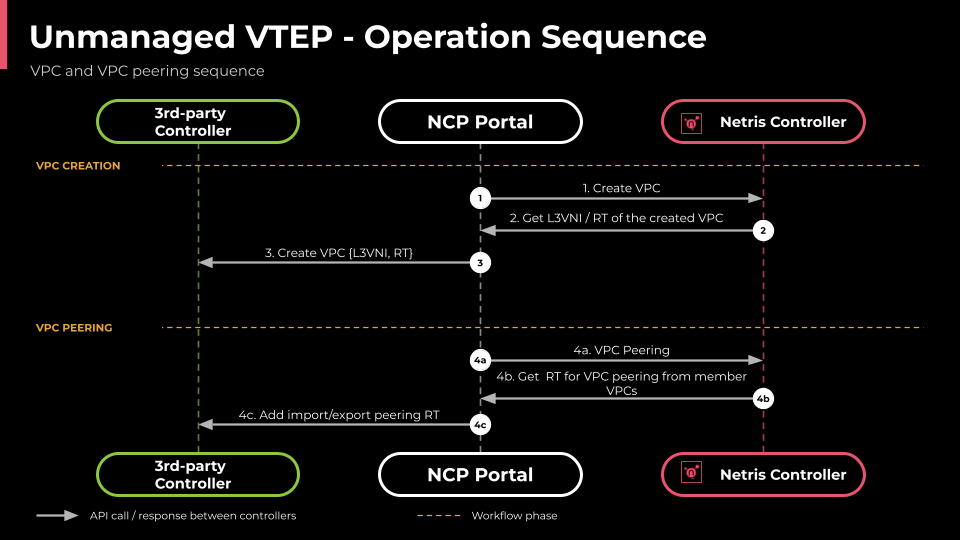
Figure: Unmanaged VTEP operation sequence for VPC creation and VPC peering
Netris remains the source of truth for VNI and route-target assignment and publishes those values through the REST API. The non-Netris system that owns those VTEPs — your own automation, a controller, a provisioning pipeline, or any other process — reads the values and configures its VTEPs to match. Netris sends no EVPN or VXLAN configuration to the unmanaged VTEP itself.
This differs from EVPN on Host, where Netris manages the host VTEP through the EVPN-on-Host agent.
What qualifies as an unmanaged VTEP
A server object in Inventory is treated as an unmanaged VTEP when both are true:
its Role is set to Generic, and
it has at least one Link to a Netris-managed switch with Underlay enabled.
Netris models the device as a server object so that the fabric side of the connection — underlay addressing, ACLs, and the BGP session toward the device — is configured as it is for any other underlay-connected node.
AS number modes
The AS Number field on the server object determines how the switch forms its BGP session toward the device.
Mode |
Behavior |
|---|---|
Assign automatically |
Netris reserves an AS number from the System ASN range and configures the switch with that specific remote AS. The system that owns the VTEP reads the assigned value from the API and configures the device to use it. |
Enter manually |
You supply the AS number the device uses. Otherwise identical to Assign automatically. |
ASN-Agnostic |
Netris assigns no AS number. The switch accepts any AS number the device presents, except the switch’s own. AS numbers are assigned outside Netris and are not registered in it. The API reports the AS number as externally managed. |
Warning
ASN-Agnostic is offered only on servers with the Generic role, and is honored only on NVIDIA Cumulus Linux switches. Dell SONiC and Arista EOS switches ignore the setting and configure no BGP session toward an ASN-Agnostic server. Use Assign automatically or Enter manually on those platforms.
Route targets
Every VNI Netris creates — a VPC’s L3VNI, a V-Net’s L2VNI, an E-BGP session’s VNI — has an import list and an export list of route targets. Each entry records why it is present.
Type |
Where it comes from |
|---|---|
|
Generated when the VNI is created, as |
|
Added as |
|
Added by you on a VPC. See L3VNI and route targets on the Netris VPC page. |
Route targets of a VPC’s L3VNI are editable. Netris generates route targets for V-Net, E-BGP, and VLAN VNIs, and they are read-only.
Edited and custom route targets on a VPC’s L3VNI are realized on NVIDIA Cumulus Linux switches only. Dell SONiC, Arista EOS, and EVPN-on-Host agents use 0:<VNI> for the VPC VRF regardless of what the VPC’s route-target lists contain. Plan custom route targets for fabrics built on Cumulus Linux.
Reading the values through the API
The system that owns the unmanaged VTEPs consumes Netris data by polling the REST API. Netris doesn’t push updates, and there’s no dedicated endpoint; a standard API user or token with read access is sufficient.
Endpoint |
What it returns |
|---|---|
|
|
|
|
|
|
|
Each member VPC’s |
|
|
|
|